
UTOPÍAS: Reimagining Wellbeing in Mexico City’s Neighbourhoods. Turning utopia into everyday reality.
Simon Ticehurst. Alternativas Económicas México and Wellbeing Economy Alliance
Utopia is often dismissed as fantasy, a beautiful idea with no place in the real world. But in Iztapalapa, a district long associated with poverty and neglect in Mexico City, the concept is being tested in practice. Through a network of community centres known as UTOPÍAS, public space is being redesigned around care, culture and collective wellbeing.
These spaces are designed especially for the traditionally marginalized: children and young people, women, older adults, and people with disabilities. Each UTOPIA offers sports facilities, art and cultural education, preventive health services and solidarity-based economic initiatives, all oriented towards community wellbeing.
The UTOPÍAS (Units for Transformation and Organisation for Inclusion and Social Harmony) were created between 2018 and 2024 under the vision of Clara Brugada, then mayor of Iztapalapa and now Mayor of Mexico City. They became the flagship programme of urban transformation and wellbeing. In a city where access to many services often depends on income, the UTOPÍAS function as a counterweight to the growing privatisation of everyday life and wellbeing.
Care at the heart
At the heart of the model lies care. Violence, particularly against women, has long been a daily reality. For this reason, each UTOPÍA includes a Casa Siempre Viva, offering free legal and psychological support for women and girls facing violence.
These centres also provide childcare modules, daytime spaces for older adults, preventive medical care through primary health clinics, guidance on nutrition and maternal health, and support for the LGBTQ+ community. The centrality of care is reflected in the fact that around 70% of users are women.
Care, however, is not limited to people. These spaces also integrate environmental education, urban gardens, agroecological plots and cooperative production. At UTOPÍA Libertad, for example, a tortilla centre sells maize produced by more than sixty local farmers organised in the Red Centli cooperative.
The milpa, the traditional cultivation of maize, beans and squash together, known as the “three sisters,” symbolises a millennia-old indigenous agroecological system. Urban gardens, medicinal plants and demonstration plots remind visitors that the relationship between economy and nature can also be regenerative.
Each UTOPÍA operates as a Tlatequio, a Nahuatl word meaning a “sacred place of gathering and cooperation for the common good” – interesting that Nahautl has one work for this! These are spaces where cooperatives, cultural initiatives and solidarity-based economic activities take root and grow.
Libertad next to the prison.
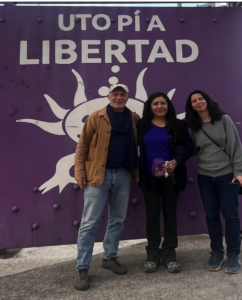
With Lia Membrillo the Coordinator of the Utopias program and and Eva Valencia from Coalición Tricolor.
Together with Eva Valencia and Rodrigo Pontón of Coalición Tricolor, we visited one of the most emblematic centres: UTOPÍA Libertad, symbolically located beside a prison complex. Guided by Lia Membrillo, coordinator of the UTOPÍAS programme, we learned that the sites chosen for these centres were not prime real estate. They were abandoned, degraded or underused areas deliberately selected as points of “urban acupuncture,” ensuring that every neighbourhood would have access to a nearby centre. Before construction began, participatory assemblies were organised in what were called “pavilions of imagination.” Here, local residents collectively designed the spaces.
One of the most innovative aspects of the programme is that it was not financed through large new funding streams. Instead, resources came from a reorientation of public spending: a 10% reduction across various government departments made it possible to concentrate funds around a shared vision and create a sense of inter-institutional co-responsibility.
Millions of people have already used the facilities, with as many as 25,000 visitors per day on weekends. Yet the most profound impact should not be measured in numbers alone.
UTOPÍAS transformed a model of compensatory government into a proactive and preventive one. Care, culture, health, environment and the economy have been integrated into a single intersectoral strategy, reshaping the conversation about what wellbeing means.
Today the model is being expanded across Mexico City, with plans to build 200 new centres in different municipalities.

A vision of the future, section of a mural at UTOPIA Libertad where they also have a planetarium.
More than infrastructure: a sense of belonging and connection.
The sustainability of these spaces comes from a powerful sense of belonging. Communities care for them because they feel they are their own. They are not seen as “government programmes,” but as a way of connecting through a shared commons.
Although all UTOPÍAS follow a common framework, each one reflects the specific needs and identity of its surrounding community.
At a time when the climate crisis, deepening inequality, social polarization and democratic decline appear to be intensifying across the world, UTOPÍAS offer a simple but powerful lesson: economic and societal transformation can begin locally, from the bottom up.
the discussion?
Let us know what
you would like
to write about!