
Charlotte Gage, Adfree Cities
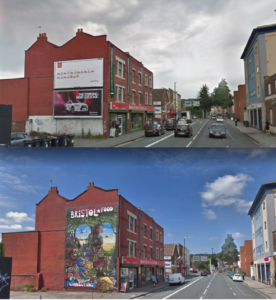 Outdoor advertising may feel like background noise — something we barely notice as we walk down the street or wait for a bus. However, there’s growing evidence showing it can affect our health, mental wellbeing, social environment and the quality of our public spaces. Adfree Cities are helping to make these impacts visible and supporting communities to push back by creating healthier public spaces for people and nature rather than profit. For example in Bristol, where activists have blocked dozens of new billboards and reclaimed public spaces.
How outdoor advertising affects wellbeing and public health
Advertising is not neutral, it doesn’t simply inform us. Its purpose is to influence behaviour, shape desires and create new needs. This has consequences for how we feel about ourselves, our communities and our environment.
The mental health impact
Advertisements often promote idealised bodies, lifestyles and versions of success that are unattainable for most people, and present consumer solutions to emotional needs. Constant exposure to these messages has been linked to lower self-esteem, body dissatisfaction, anxiety and feelings of inadequacy, particularly among young people. Unlike online or television advertising, outdoor ads are unavoidable — you cannot turn them off or opt out. They occupy the spaces we move through every day, from streets to bus stops to neighbourhoods outside our homes.
From a mental health perspective, this constant, unsolicited messaging adds to cognitive overload and stress. Public space becomes a site of pressure rather than rest, stimulation rather than reflection.

Public health and inequality
From a public health perspective, the content of outdoor advertising is just as concerning as its volume. Studies show that billboards and digital screens disproportionately promote unhealthy commodities — including junk food, sugary drinks, alcohol, gambling, high-interest credit, and high-carbon products.
These ads are also more concentrated in lower-income areas, reinforcing existing health inequalities. Exposure is linked to higher consumption and normalisation of unhealthy behaviours, contributing to obesity, addiction and poor long-term health outcomes. In this way, advertising is a commercial determinant of health.
Digital screens, light pollution and stress
The rapid growth of digital advertising screens has intensified these effects. Bright, animated displays are designed to capture attention, but they can also cause sensory overload, disrupt sleep for nearby residents, increase stress and pose safety risks by distracting drivers and pedestrians. What is marketed as “urban innovation” often comes at the cost of wellbeing.
How advertising works on us: Techniques and psychological effects
Outdoor advertising isn’t static. It has evolved, employing psychological and technological innovations that increase its impact on our daily lives. Modern advertising uses sophisticated techniques that go far beyond simple promotion:
- Dynamic digital screens rotate messages every few seconds, constantly pulling attention and preventing visual rest.
- Targeted messaging turns public spaces into semi-surveillance environments where ads can track and target people — who haven’t opted in to be marketed at. Many new screens contain cameras and surveillance technology that can collect data or respond to nearby audiences to target consumers.
- Scarcity and urgency cues (“limited time”, “last chance”) trigger anxiety and impulsive behaviour.
- Emotional targeting links products to feelings of belonging, success, love or relief from stress.
- Placement in public space ensures exposure is unavoidable — turning streets, transport hubs and residential areas into permanent marketing channels.
Together, these techniques shift how we experience public space. Instead of places for connection, access to nature, movement or pause, they become environments designed to stimulate desire and consumption.
Consumerism and wellbeing: More than a spending habit
 Advertising doesn’t just sell individual products — it sustains a wider culture of consumerism, where buying is framed as the primary route to happiness, status and belonging. This has deep implications for wellbeing.
Large corporations invest billions in advertising to turn social moments into shopping events. In 2024, Amazon alone spent an estimated $21 billion on advertising worldwide, including millions on Out-of-Home ads across the UK that fill our streets and screens with calls to consume. Shopping seasons bleed into one another, creating constant pressure to spend, upgrade and keep up by creating a sense that buying more is not only normal but necessary.
This pressure takes a psychological toll. Advertising fuels fear of missing out and social comparison, encouraging people to measure care, success or generosity through material goods. While consumption can deliver short-term pleasure, it rarely provides lasting satisfaction. Instead, it often leads to stress, financial anxiety, guilt and disappointment — particularly for those who cannot afford to participate at the level advertising suggests is “normal”.
There is also an environmental and emotional feedback loop. High-consumption generates vast amounts of waste and carbon emissions, contributing to climate anxiety and a sense of powerlessness about the future. When happiness is consistently framed as something to be bought rather than built through relationships, creativity or community, people are left chasing fulfilment that never quite arrives.
Beyond environmental effects, there’s a deeper emotional cost to equating happiness with consumption. Constant marketing messaging suggests that more stuff equals more happiness or social worth. This can skew how we assess our relationships, success and self-worth — reinforcing the idea that external purchase decisions are pathways to internal contentment. When the acquistive cycle fails to deliver lasting fulfilment, it can contribute to feelings of emptiness, anxiety and burnout.
Reducing the influence of pervasive consumerism — reinforced by advertising — is not just about spending less. It’s about reclaiming our time, attention and social values from a corporate logic that equates wellbeing with over-consumption. Reducing exposure to advertising — especially in shared public spaces — can help loosen this grip. It creates room for alternative values: connection over consumption, sufficiency over excess, and wellbeing that is not tied to purchasing power. Supporting local economies can also help to shift cultural expectations and connect to local communities.
Bristol: A case study in reclaiming public space
Bristol offers a powerful example of how communities can challenge advertising’s impact on wellbeing.
The problem: Digital screen invasion
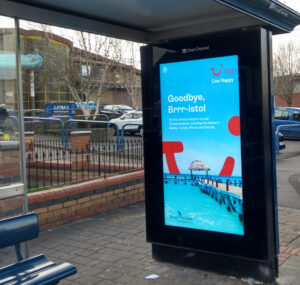 Like many other cities, Bristol has seen an increase in applications for new digital advertising screens, including large, bright displays in residential areas and near busy roads. These screens are not useful additions; they are visual noise, technological intrusion, and threats to wellbeing. Residents reported feeling stressed, overwhelmed by brightness, and irritated by corporate messaging in public spaces. People living near major digital screens have described light sensitivity, disrupted sleep, and intrusion into their homes as the presence of advertising harms local quality of life. However, once screens are installed there is little that can be done to remove them or restrict what is shown.
Community action: block, lobby, reimagine
Local activists formed Adblock Bristol in 2017, part of the Adfree Cities network. Through sustained grassroots organising, they:
- Mobilised public objections to planning applications. This grassroots pressure has led to over 45 large new digital advertising billboards proposed across the city being blocked by Bristol City Council, as well as repeated refusals of BT’s Street Hub proposals.
- Worked with Bristol City Council to introduce an Advertising and Sponsorship Policy restricting ads for junk food, alcohol, gambling and payday loans on council-owned sites — prioritising public health.
- Reimagined advertising spaces with community art, murals and creative installations. Rather than just saying “no,” Adblock Bristol, alongside local artists and groups, have reclaimed ad space for community-focused art and nature.

The outcome: prioritising wellbeing
The results go beyond fewer billboards. Bristol has demonstrated that advertising policy can be a shift in the way the city thinks about public space, wellbeing and community health, reducing exposure to harmful messaging and reclaiming shared environments. The city has become an example of how local action can influence urban wellbeing, support the local economy and address over-consumption.
What Bristol’s example shows us:
- Public health and advertising are connected. Reducing exposure to unhealthy or distracting advertising is a public health intervention — especially for children and vulnerable populations who are disproportionately impacted.
- Community mobilisation works. Grassroots objections and sustained engagement with local government can influence planning decisions and lead to healthier cities.
- Public space can be reclaimed. Instead of passive consumption, spaces can celebrate art, nature and community identity — boosting wellbeing and citizen pride.
Reimagining public space for health and wellbeing
 Public spaces shape how we feel. When they are dominated by advertising, they reinforce stress, comparison and consumption. Outdoor advertising is more than consumer messaging — it’s an immersive presence in our cities that affects how we feel, how we interact and how we perceive value. By recognising its public health impacts, understanding its techniques, and acting collectively as communities, we can reclaim streets, parks and public spaces — not as billboards for consumption, but as places where wellbeing and community can thrive.
The work of Adfree Cities shows that change is possible — by questioning who public space is for and by reducing the commercial pressures that surround us, we can create cities that support wellbeing rather than undermine it.
If our cities are to be truly healthy, they must be places where people — not brands — are centre stage.
What you can do next
Adfree Cities offers three simple actions anyone can take to push for ad-free, healthier cities:
- Object to new ad planning applications in your area.
- Connect with your local Adblock group — or start your own — to organise, lobby and imagine alternatives.
- Encourage your local council to introduce a healthier Advertising and Sponsorship Policy on the ad sites they control.